Research use only — not for human consumption. Not evaluated by the MHRA or FDA.
Peptides
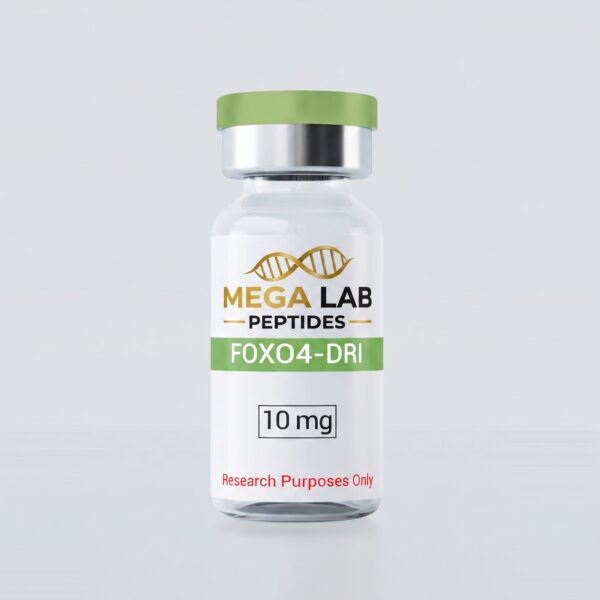
FOXO4-DRI 10mg
10 mg · Lyophilised powder
Order by 2pm for same-day dispatch. Free UK next-day tracked delivery.
| Form | Lyophilised powder |
|---|---|
| Purity specification | ≥ 99% by HPLC (supplier specification) |
| Storage | −20°C lyophilised · 2–8°C once reconstituted |
Research Overview
What FOXO4-DRI is
FOXO4-DRI is a synthetic peptide designed to interfere with the interaction between the transcription factor FOXO4 and the tumour suppressor p53. It is built as a D-retro-inverso (DRI) peptide: the sequence is assembled from D-amino acids in reverse order, which preserves the side-chain topology of the original L-peptide while conferring resistance to proteolytic degradation. It incorporates a cell-penetrating segment to facilitate uptake in cell-culture systems.
Research background
FOXO4-DRI was described by Baar and colleagues in a 2017 paper in the journal Cell, which reported selective effects on senescent cells in culture and in mouse models. It has since become a widely used tool compound in the senolytics field, employed to probe FOXO4–p53 signalling and the biology of cellular senescence. It is an investigational compound with no approved therapeutic use; Megalab supplies it as a research reagent only.
Specification
Each vial contains 10mg of FOXO4-DRI as a lyophilised powder. Purity is verified by HPLC at ≥99% on every batch. The batch record on this page identifies the current lot where published, and a Certificate of Analysis is available on request.
Handling and storage
Store unopened vials at −20°C, protected from light. Allow the vial to reach room temperature before opening. FOXO4-DRI is a comparatively large, hydrophobic peptide; add bacteriostatic water slowly and allow full hydration before gentle swirling. Store reconstituted solution at 2–8°C and use within 30 days.
Supplied for laboratory research use only.
Reconstitution & storage
- Diluent
- Bacteriostatic water, added slowly down the inside wall of the vial; swirl, do not shake.
- Lyophilised
- Store at −20°C, away from light and moisture.
- Reconstituted
- Refrigerate at 2–8°C.
Frequently Asked Questions
What does D-retro-inverso mean?
The peptide is synthesised from D-amino acids (the mirror image of the natural L-form) arranged in reverse sequence order. This retains the spatial arrangement of side chains while making the peptide resistant to proteases.
What is FOXO4-DRI used to study?
It is a tool compound for research into cellular senescence, specifically the FOXO4–p53 interaction described in the 2017 Cell paper by Baar et al.
Does FOXO4-DRI dissolve easily?
It is slower to dissolve than short linear peptides. Add diluent gradually, let the powder hydrate, and swirl gently rather than shaking.