Research use only — not for human consumption. Not evaluated by the MHRA or FDA.
Peptides
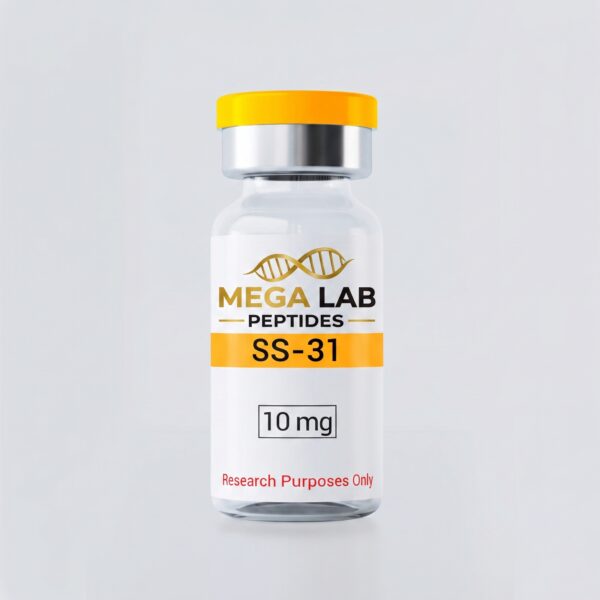
SS-31 10mg
10 mg · Lyophilised powder
Order by 2pm for same-day dispatch. Free UK next-day tracked delivery.
| Form | Lyophilised powder |
|---|---|
| Purity specification | ≥ 99% by HPLC (supplier specification) |
| Storage | −20°C lyophilised · 2–8°C once reconstituted |
Research Overview
What SS-31 is
SS-31, generic name elamipretide, is a synthetic tetrapeptide with the sequence D-Arg-Dmt-Lys-Phe-NH2, where Dmt is 2′,6′-dimethyltyrosine. Its molecular weight is approximately 640 Da. It belongs to the Szeto-Schiller family of peptides, developed by Hazel Szeto and Peter Schiller, which are characterised by alternating aromatic and basic residues. This motif allows the peptide to concentrate in the inner mitochondrial membrane independently of membrane potential.
Research background
SS-31 is a widely used tool compound in mitochondrial research. Published work describes its binding to cardiolipin, a phospholipid specific to the inner mitochondrial membrane, and examines its effects on cristae structure, electron transport chain efficiency and reactive oxygen species production in cell culture and animal models. It has been studied through clinical development for mitochondrial conditions. Megalab supplies SS-31 for in-vitro research only.
Specification
Each vial contains 10mg of SS-31 as a lyophilised powder. Purity is verified by HPLC at ≥99% on every batch. Lot information appears in the batch record on this page where published, and a Certificate of Analysis is available on request.
Handling and storage
Store unopened vials at −20°C, protected from light. Bring to room temperature before opening. SS-31 is water-soluble and dissolves readily; add bacteriostatic water down the vial wall and swirl gently. Store reconstituted solution at 2–8°C and use within 30 days.
Supplied for laboratory research use only.
Reconstitution & storage
- Diluent
- Bacteriostatic water, added slowly down the inside wall of the vial; swirl, do not shake.
- Lyophilised
- Store at −20°C, away from light and moisture.
- Reconstituted
- Refrigerate at 2–8°C.
Frequently Asked Questions
What does “SS” stand for in SS-31?
Szeto-Schiller, after the two researchers who developed the peptide family. Elamipretide is the generic name for SS-31 specifically.
Why does SS-31 accumulate in mitochondria?
Its alternating aromatic-cationic structure gives it affinity for cardiolipin in the inner mitochondrial membrane, allowing it to concentrate there without depending on membrane potential.
What is Dmt?
2′,6′-dimethyltyrosine, a non-natural tyrosine derivative at position 2 of the sequence that contributes to the peptide’s stability and membrane interaction.