Research use only — not for human consumption. Not evaluated by the MHRA or FDA.
Peptides
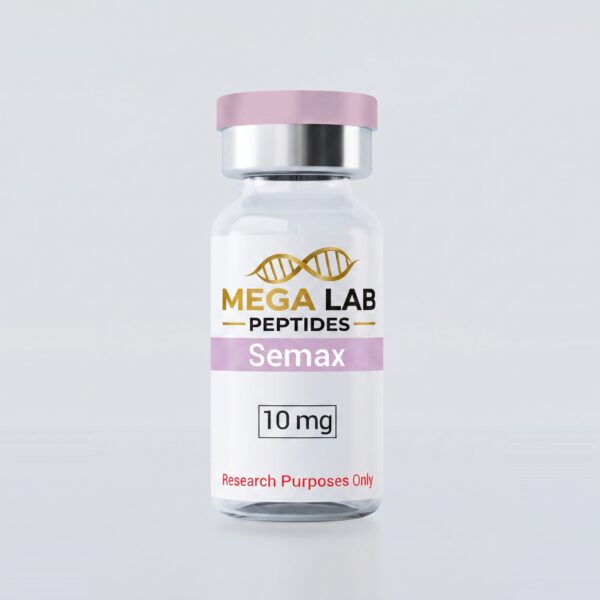
Semax 10mg
10 mg · Lyophilised powder
Order by 2pm for same-day dispatch. Free UK next-day tracked delivery.
| Form | Lyophilised powder |
|---|---|
| Purity specification | ≥ 99% by HPLC (supplier specification) |
| Storage | −20°C lyophilised · 2–8°C once reconstituted |
Research Overview
What Semax is
Semax is a synthetic heptapeptide with the sequence Met-Glu-His-Phe-Pro-Gly-Pro and a molecular weight of approximately 813 Da. Its first four residues correspond to fragment 4–7 of adrenocorticotropic hormone (ACTH), a region that has no corticotropic activity of its own; the C-terminal Pro-Gly-Pro extension was added to protect the fragment from rapid enzymatic degradation. It was developed at the Institute of Molecular Genetics in Moscow in the 1980s.
Research background
Semax has been studied in rodent models of cerebral ischaemia and in behavioural paradigms, with published work examining its effects on expression of brain-derived neurotrophic factor (BDNF) and its receptor TrkB, on gene-expression patterns in brain tissue, and on enkephalin degradation. As with Selank, the majority of the primary literature is Russian in origin and a substantial proportion is not available in English, which limits independent evaluation. Megalab supplies Semax as a laboratory reagent only.
Specification
Each vial contains 10mg of Semax as a lyophilised powder. Purity is verified by HPLC at ≥99% on every batch. The batch record on this page identifies the current lot where published; a Certificate of Analysis is available on request.
Handling and storage
Store unopened vials at −20°C, protected from light. The N-terminal methionine is susceptible to oxidation; minimise air exposure once the vial is opened. Bring to room temperature before opening, reconstitute with bacteriostatic water added down the vial wall, and swirl gently. Store reconstituted solution at 2–8°C and use within 30 days.
Supplied for laboratory research use only.
Reconstitution & storage
- Diluent
- Bacteriostatic water, added slowly down the inside wall of the vial; swirl, do not shake.
- Lyophilised
- Store at −20°C, away from light and moisture.
- Reconstituted
- Refrigerate at 2–8°C.
Frequently Asked Questions
What part of ACTH does Semax contain?
Residues 4 to 7 (Met-Glu-His-Phe), a fragment with no corticotropic activity, extended by Pro-Gly-Pro.
Why is Semax sensitive to oxidation?
Its N-terminal methionine can oxidise to methionine sulfoxide on exposure to air. Keep reconstituted solution sealed and refrigerated.
Is Semax related to Selank?
They share the Pro-Gly-Pro C-terminal tail and the same institutional origin, but their N-terminal sequences derive from different parent molecules.