Research use only — not for human consumption. Not evaluated by the MHRA or FDA.
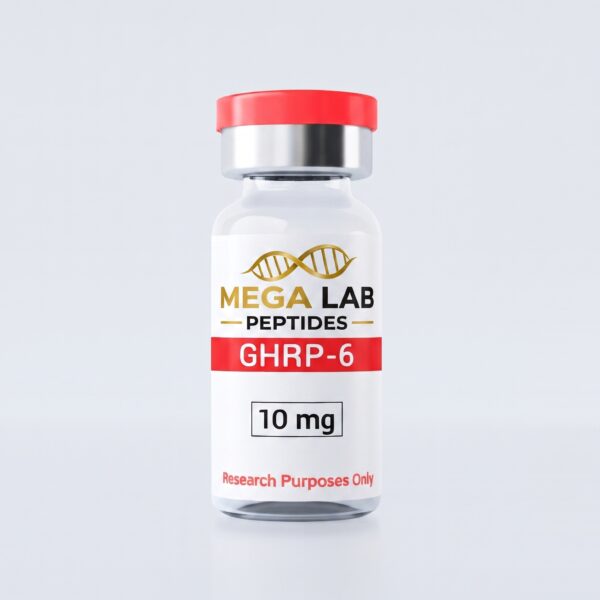
Peptides
GHRP-6 10mg
10 mg · Lyophilised powder
Order by 2pm for same-day dispatch. Free UK next-day tracked delivery.
| Form | Lyophilised powder |
|---|---|
| Purity specification | ≥ 99% by HPLC (supplier specification) |
| Storage | −20°C lyophilised · 2–8°C once reconstituted |
Research Overview
What GHRP-6 is
GHRP-6 (Growth Hormone Releasing Peptide-6) is a synthetic hexapeptide with the sequence His-D-Trp-Ala-Trp-D-Phe-Lys-NH2 and a molecular weight of approximately 873 Da. It was developed in the early 1980s by Cyril Bowers and colleagues as one of the first synthetic growth-hormone secretagogues, predating the discovery of ghrelin. The two D-amino acids in the sequence contribute to its stability against enzymatic breakdown.
Research background
GHRP-6 occupies an important place in endocrinology research because work on its mechanism led directly to the identification of the growth-hormone secretagogue receptor (GHS-R1a), now known as the ghrelin receptor. It remains a standard tool compound in receptor pharmacology, used in cell-based assays and animal models to characterise secretagogue signalling. Megalab supplies GHRP-6 for in-vitro research only.
Specification
Each vial contains 10mg of GHRP-6 as a lyophilised powder. Purity is verified by HPLC at ≥99% on every batch. The current lot is shown in the batch record on this page where published, and a Certificate of Analysis is available on request.
Handling and storage
Store unopened vials at −20°C and protect from light. Allow to reach room temperature before opening. Reconstitute with bacteriostatic water added slowly down the inside of the vial, swirling gently. Store reconstituted solution at 2–8°C and use within 30 days.
Supplied for laboratory research use only.
Reconstitution & storage
- Diluent
- Bacteriostatic water, added slowly down the inside wall of the vial; swirl, do not shake.
- Lyophilised
- Store at −20°C, away from light and moisture.
- Reconstituted
- Refrigerate at 2–8°C.
Frequently Asked Questions
How does GHRP-6 differ from Ipamorelin?
Both are synthetic secretagogues acting at the ghrelin receptor. GHRP-6 is a hexapeptide from the first generation of such compounds; Ipamorelin is a later pentapeptide designed for greater receptor selectivity. Researchers choose between them based on the selectivity profile their protocol requires.
Why does the sequence contain D-amino acids?
The D-Trp and D-Phe residues make the peptide more resistant to enzymatic degradation than an all-L sequence would be.
What documentation is supplied with GHRP-6?
Every batch is released at ≥99% purity by HPLC. The batch record on this page shows the current lot, and a full Certificate of Analysis is available on request.